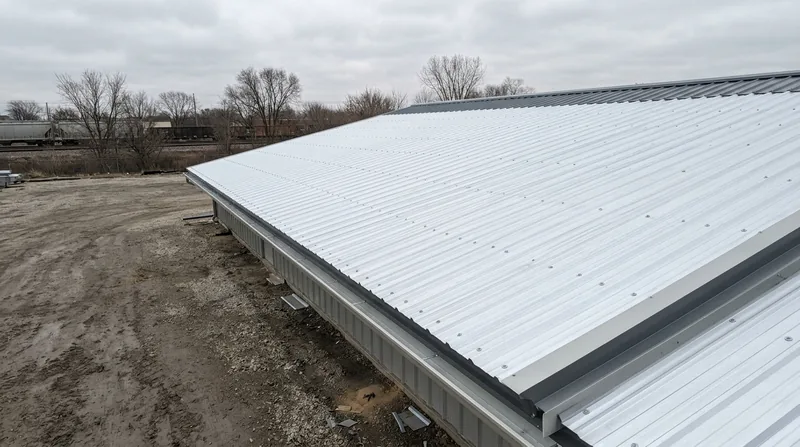




Chicago sits on a flat glacial lake plain where wet snow, ice dams, and freeze-thaw cycles hammer every roof from the Bungalow Belt to the collar county farmsteads. Commercial & Agricultural Metal Roofing in Chicago means panel systems built for barns, workshops, churches, garages, and light commercial buildings that have to shed heavy snow and stand up to derecho winds. We install and repair exposed-fastener and standing seam systems across Cook County, from Bridgeport and Cicero shops to southwest suburban machine sheds. The lake-effect gray sky and long humid summers punish cheap fasteners and thin gauges, so we spec panels and insulation for this climate. Call (872) 242-4810 for a free on-site look. See our metal roof installation service for the residential side of the same work.
Why Commercial and Agricultural Metal Roofing Matters on the Chicago Lake Plain
Most of the commercial and agricultural roofs we see around Chicago were built cheap and fast: 29-gauge ribbed panels on purlins, screw-fastened, with minimal insulation. That works until a January ice dam backs water under the laps or a July hail storm dimples the panels and wallows out the washers. On the flat clay soil and open exposure of the southwest suburbs, wind uplift is the other killer, and a failed ridge cap on a Joliet machine shed can peel a whole roof in one gust.
- Heavy wet snow loads test purlin spacing and fastener pull-out on every barn and shop roof.
- Ice dams at eaves and valleys force meltwater sideways under panel laps and into insulation.
- Hail and derecho winds loosen screws, oval out washers, and lift ridge and eave trim.
- Summer heat and humidity cook thin underlayments and rust cut edges on older panels.
- Falling limbs from street elms, maples, and honeylocusts puncture and dent low-slope panels.
We fix the cause, not just the leak, because a patched screw hole on a Cook County shop roof will weep again by the next thaw.
Key info: A Cicero auto shop with a 30-year-old ribbed roof called us after ice dam water stained the office ceiling. The panels were sound but the washers were shot and the eave trim was backsloped. We re-fastened the field, reset the trim, and added closure strips, which stopped the leak without a full tear-off.
For permit thresholds and inspection rules, always confirm with the local building department, since requirements vary by jurisdiction. The City of Chicago Department of Buildings publishes its permit rules at chicago.gov.
How We Approach a Commercial or Agricultural Metal Roof in Chicago
We start on the ground, not on the roof. A walkaround tells us panel gauge, fastener condition, purlin spacing, and where the water is actually going. Then we get on the roof with a probe and a moisture meter, check the deck and insulation, and photograph every failure point. You get a written scope with panel profile, gauge, fastener type, and insulation R-value spelled out before anyone orders material.
- We inspect the deck, purlins, and existing panels and document every leak path with photos.
- We measure the roof and calculate snow load, wind uplift, and insulation needs for the building use.
- We recommend a panel system (exposed fastener, standing seam, or retrofit) and write a fixed scope.
- We pull the permit with the local building department and schedule around your operating hours.
- We tear off or recover, install underlayment and panels, and flash every penetration and transition.
- We walk the roof with you at completion and hand over fastener and panel documentation.
Every job ends with a punch walk and a written record of what was replaced, so the next contractor or buyer knows exactly what is up there.
Key info: A church in Oak Park had a steeple and a low-slope fellowship hall roof leaking at the same wall. We replaced the hall panels with standing seam and re-flashed the steeple transition in copper, then tied both into new gutters. One scope, one crew, no finger-pointing between trades.
If your building sits in one of the historic districts or HOA-governed corridors, check design review before you pick a panel profile or color. Our Oak Park metal roofing page covers how that review works in practice.
Panel Systems We Install on Chicago Commercial and Agricultural Buildings
There is no single right panel for every building. A machine shed in Joliet and a retail building in Bridgeport have different snow, wind, and appearance demands, and the roof has to match how the building is used. Here is how the main approaches compare in this climate.
| Approach | Description | Best for |
|---|---|---|
| Exposed-fastener ribbed panels | Screw-down 29 or 26 gauge panels with exposed washers, fast to install and easy to repair. | Barns, shops, garages, and budget-driven agricultural buildings. |
| Standing seam | Concealed-fastener panels with raised seams, no exposed screws, better wind and snow performance. | Churches, retail, and light commercial buildings where leaks and looks matter. |
| Insulated panel systems | Factory-insulated panels that combine roof and insulation in one pass, with high R-value. | Heated shops, cold storage, and buildings where condensation is a problem. |
| Retrofit over existing panels | New panels and underlayment installed over sound existing metal, subject to code limits. | Older buildings with good structure where a tear-off is not practical. |
| Repair and re-fastening | Screw replacement, washer renewal, trim reset, and targeted leak repair on sound panels. | Roofs with good panels but failed fasteners and flashing. |
We will tell you when a repair is the right call and when it is throwing money at a roof that needs replacement. That call is based on panel gauge, rust at cut edges, and fastener condition, not on what is easier to sell.
Commercial & Agricultural Metal Roofing Cost in Chicago: What to Expect
Every commercial and agricultural metal roofing cost in Chicago starts with a free estimate, because the number depends on the building, not a price list. Panel gauge, roof square footage, pitch, tear-off versus retrofit, insulation, and how many penetrations and transitions the roof has all move the figure. Access matters too: a Bridgeport shop with a flat roof and alley access prices differently than a barn surrounded by fields in Joliet.
Expect a meaningful spread between the low bid and a properly scoped job, and ask what is excluded. The cheapest quote often leaves out underlayment, closure strips, or snow guards, and those items come back as change orders. Get two or three estimates, compare scope line by line, and make sure each one names the panel profile and gauge. Our pricing overview breaks down what drives the number in more detail.
We do not promise insurance coverage, and no contractor can waive or absorb your deductible. What we do is document damage with photos and measurements so your adjuster has what they need to review the claim.
What to Look for When Hiring a Metal Roofing Contractor Near Chicago
Hiring for a commercial or agricultural metal roof near Chicago is different from hiring for a house. The building is often occupied, the roof may be low-slope and large, and the wrong panel or fastener will fail within a few winters. Take the time to check the basics before you sign.
- Confirm the contractor is licensed and insured for commercial work and ask for a certificate of insurance.
- Get two or three written estimates and compare panel gauge, fastener type, and what is excluded.
- Ask for references on similar buildings (barns, shops, churches) and call them.
- Verify who pulls the permit with the local building department and who pays for inspection re-visits.
- Check historic district or HOA design review rules before you settle on panel profile and color.
A contractor who cannot explain snow load, wind uplift, and fastener selection for your building is not the right one for this roof. When you are ready to talk scope, contact us and we will set up a site visit.
Commercial & Agricultural Metal Roofing in Chicago: Pricing Guide
| Service | Price | Details |
|---|---|---|
| Leak repair on commercial or agricultural metal roof | Free estimate | Includes roof inspection and written scope; price moves with leak count, panel height, and access difficulty. |
| Screw replacement and re-fastening | Starting at $1,200 | Covers failed fasteners, washers, and trim reset; final price depends on roof square footage and fastener count. |
| Exposed-fastener panel replacement | Starting at $4.50 per sq ft | Includes tear-off, underlayment, and new ribbed panels; gauge, pitch, and insulation move the number. |
| Standing seam installation | Starting at $9 per sq ft | Concealed-fastener panels with new underlayment and trim; height, penetrations, and snow guards add cost. |
| Complex or large-scale job | On estimate | Large barns, churches, and multi-building sites need an on-site look at deck, purlins, and access before pricing. |
| Estimate | Free | Response within 24h at (872) 242-4810, no obligation to book. |
Indicative pricing, the exact cost depends on square footage, finish, and site access. Free personalized estimate within 24h at (872) 242-4810.


