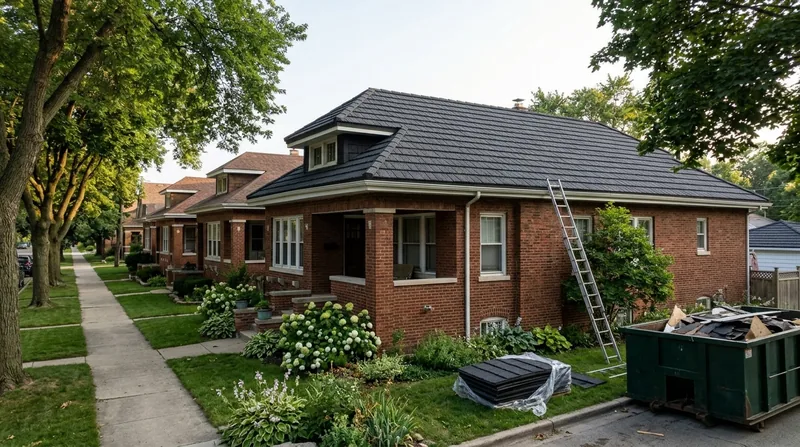




Stone-Coated Steel Roofing in Chicago is the system that finally makes sense on a city full of low-pitch bungalow hips and steep Victorian gables that eat asphalt shingles every fifteen years. Chicago sits on a flat glacial lake plain of heavy clay, under lake-effect wet snow, hard freeze-thaw cycling, hail, and derecho wind, with elm, maple, honeylocust, oak, and ash limbs hanging over the roofs. A stone-coated panel gives you the slate or shake texture the Bungalow Belt and the Beverly Victorians were designed around, but the panel is steel, and it holds up to hail, wind, and ice. We install it as a full system: underlayment, edge metal, valley metal, and fasteners sized for the Chicago climate, not a generic kit dropped on a roof. If you are still weighing panel types, start with our metal roof installation overview and then come back to stone-coated.
Why Stone-Coated Steel Belongs on Chicago Roofs, Not Just Any Roof
The dominant failure mode in this city is not sun. It is water backing up under the courses at ice dams, then freeze-thaw prying the shingle mat apart and rotting the deck along the eaves. Stone-coated steel panels interlock and bridge those cycles, and the granular stone surface takes hail hits that granule-loss shingles never survive. On the thousands of brick bungalows from Jefferson Park to Oak Lawn, the low hip pitch is exactly where asphalt gives out first, and where a textured steel panel can match the original look.
- The stone granule surface absorbs hail impact and hides the dents that bare steel would show after a Cook County storm.
- The interlocking profile sheds wet lake snow instead of letting it creep under the laps at the eaves.
- Profiles reproduce the slate and shake looks the Georgians in Lincoln Park and the Queen Annes in Oak Park were built with.
- The steel core carries a Class A fire rating and resists the wind uplift that peels shingle tabs in a derecho.
- It weighs far less than real slate or concrete tile, so most Chicago frame and brick decks carry it without structural work.
On a city roof, the panel is only half the job. The underlayment, the ice-and-water membrane at the eaves, and the flashing do the work that keeps a Chicago winter out.
Key info: On a 1920s bungalow in Portage Park with a low hip roof, we routinely find the original 1x deck boards sound but the eave membrane gone. Stone-coated panels over a new high-temp underlayment and a full ice-and-water shield at the eaves solve the ice-dam rot that keeps coming back every spring.
Before you commit to any roof system, verify what your local building department requires. The City of Chicago Department of Buildings publishes its permit and inspection rules at chicago.gov, and the thresholds vary by jurisdiction across Cook County.
How We Install Stone-Coated Steel on a Chicago Roof
We start by stripping to the deck, because a stone-coated system over old shingles on a Chicago roof hides the rot you need to see. We inspect the sheathing, replace soft deck boards, and check the chimney and skylight curbs before a single panel goes up. The sequence below is what you should expect on your property, whether it is a two-flat in Logan Square or a subdivision home in Naperville.
- We tear off the existing roof down to the deck and haul it away the same day.
- We inspect and replace any soft sheathing, then re-nail the deck to current code.
- We install high-temp underlayment and a full ice-and-water shield along the eaves and in the valleys.
- We set new edge metal, valley metal, and step flashing at the walls and chimneys.
- We lay the stone-coated panels in the manufacturer's sequence, locking each course and fastening to the pattern.
- We flash the chimney, skylights, and vent boots, then seal and test them.
- We clean the gutters, magnet-sweep the yard, and walk the roof with you before we leave.
Every panel course gets checked for alignment before we move up the roof, because a stone-coated roof that is not square shows it from the street.
Key info: On a steep Queen Anne gable in Beverly, the original slate was gone but the turret and bay still had their copper. We ran stone-coated panels on the main slopes and tied the new work into the existing copper valleys so the house kept its look and stopped leaking.
If your home is in a historic district or under HOA design review, get the profile and color approved before the order is placed. Our metal shingle roofing page covers the profiles that most often pass review.
Stone-Coated Steel Approaches We Use in Chicago
Not every Chicago roof wants the same panel. A low-pitch bungalow hip, a steep Victorian gable, and a 1990s subdivision roof in Schaumburg each call for a different profile and fastening method. The table below shows the approaches we install most often and where each one fits.
| Approach | Description | Best for |
|---|---|---|
| Stone-coated shake profile | Textured panel that mimics cedar shake, installed with concealed fasteners and interlocking courses. | Bungalows and Cape Cods where the original look was shake or weathered shingle. |
| Stone-coated slate profile | Rectangular slate-look panel with a granular surface, cut and flashed at valleys and hips. | Georgians in Lincoln Park and Victorians in Beverly and Hyde Park. |
| Low-pitch hip system | Panel laid over a full ice-and-water shield with a sealed sidelap for shallow slopes. | The thousands of low hip roofs along the Bungalow Belt. |
| Retrofit over existing shingles | Panel installed over a prepared existing roof where code allows the existing layer count. | Subdivision homes in Naperville and Orland Park with one sound shingle layer. |
| Storm and hail replacement | Damaged panels and flashing replaced and tied back into the existing field. | Roofs hit by hail or wind in Cicero, Berwyn, and the inner suburbs. |
We match the profile to the house and the pitch, not to whatever is on the truck, and we tell you when a retrofit is not allowed by the local layer limit.
Stone-Coated Steel Roofing Cost in Chicago: What to Expect
Stone-coated steel pricing in Chicago starts around From $9/sq ft installed, and that figure moves with the roof, not with the sales pitch. A simple gable on a Schaumburg subdivision home sits near the low end, while a cut-up Beverly Victorian with turrets, valleys, and three dormers sits well above it. We give you a real number after we see the deck, the flashing, and the access.
- Roof complexity drives the number: hips, valleys, dormers, and turrets mean more cutting and more flashing.
- Pitch and access matter: a steep gable needs staging and fall protection, and a tight Logan Square lot slows the tear-off.
- Deck condition matters: soft sheathing and rotted fascia add carpentry before the panels go down.
- Chimney, skylight, and wall flashing work adds labor that a plain roof does not carry.
- Panel profile and color choice affect material cost, and some premium colors carry a longer lead time.
Get two or three written estimates on the same scope, and make sure each one lists the underlayment, the ice-and-water shield, and the flashing, not just the panel. Our full pricing overview breaks down what each line covers.
Stone-Coated Steel Roofing Near Me: How to Pick a Contractor Near Chicago
You will see plenty of crews advertising stone-coated steel near me in Chicago, and most of them are brokers who sub the work out. Ask for the Illinois roofing license and the certificate of insurance before anyone walks your roof, and call the number on the certificate to confirm it is current. Ask for three local references on homes like yours, and ask whether the crew that shows up is the crew that quoted the job.
Permits are required for most full replacements in Chicago and across Cook County, and the rules vary by jurisdiction, so confirm who pulls the permit and who pays for the inspection. If your home is in a historic district or an HOA, get the profile and color approved in writing before the order is placed. A contractor who cannot answer those questions before the contract is signed will not answer them after.
When you are ready for a written scope and a real number, reach out through our contact page and we will set a time to look at the roof.
Stone-Coated Steel Roofing in Chicago: Pricing Guide
| Service | Price | Details |
|---|---|---|
| Stone-coated steel roof replacement, standard gable | Starting at $9/sq ft | Includes tear-off, underlayment, ice-and-water shield, edge metal, and panels on a simple gable roof. |
| Stone-coated steel on a low-pitch bungalow hip | Starting at $10.50/sq ft | Adds full ice-and-water shield and sealed sidelaps for shallow Chicago hip pitches. |
| Cut-up roof with valleys, dormers, or turrets | Starting at $13/sq ft | More cutting, flashing, and staging on Victorian and Queen Anne roof lines. |
| Retrofit over one existing shingle layer | Starting at $8/sq ft | Where local code allows the existing layer count and the deck checks out. |
| Storm or hail panel replacement | On estimate | Scope depends on how many panels and flashings the hail or wind damaged. |
| Estimate and roof inspection | Free | Response within 24 hours at (872) 242-4810, no obligation to book. |
Indicative pricing, the exact cost depends on square footage, finish, and site access. Free personalized estimate within 24h at (872) 242-4810.


