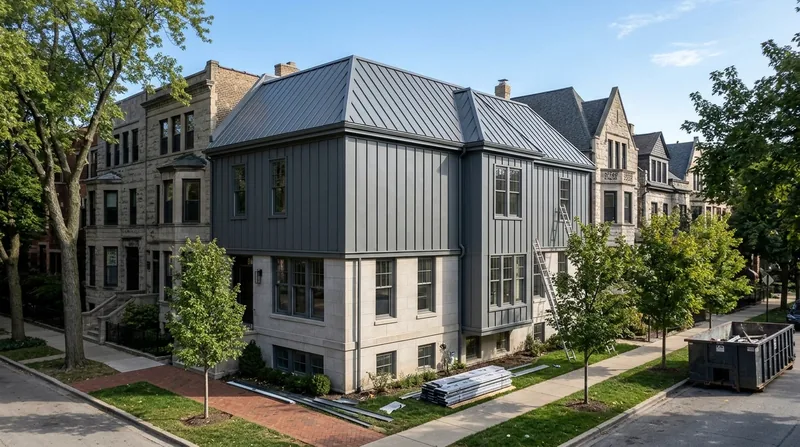




Standing seam metal roofing in Chicago is the concealed-fastener system that fits this city's wet snow, ice dams, and freeze-thaw swings better than any exposed-screw panel. We roll-form panels to length on site and mechanically seam them so there are no screws to back out when the temperature drops twenty degrees overnight. Chicago sits on a flat glacial lake plain with heavy clay soil, and our roofs take lake-effect snow, hail, and derecho winds across the Bungalow Belt, the greystones of Lincoln Park, and the steep gables of Beverly. For homeowners along the Northwest and Southwest Sides and out to Naperville and Orland Park, a standing seam roof is a 40-to-50-year decision, not a patch. If you are weighing options, start with our metal roof installation overview before you pick a profile.
Why Standing Seam Matters on Chicago's Bungalows, Two-Flats, and Subdivision Homes
Chicago roofs fail from the top down in freeze-thaw cycles. Water works into seams, refreezes, and pries fasteners loose. On the low-pitched hip roofs of the Bungalow Belt and the flat-to-shallow roofs of Logan Square and Bridgeport two-flats, an exposed-screw panel gives ice a grip point. Standing seam eliminates that grip. The panels float on clips, expand and contract as one piece, and shed wet snow before it can dam at the eave.
- Concealed clips let the roof move through Chicago's deep freeze-thaw swings without loosening a single fastener.
- The smooth raised-seam profile sheds heavy wet snow and reduces ice-dam risk at eaves and valleys.
- Mechanically seamed panels carry high wind-uplift ratings for the hail and derecho events that hit Cook County.
- Panels roll-formed to length mean fewer end laps and fewer places for water to sit on a low-slope Chicago roof.
For a brick two-flat in Berwyn or a 1990s two-story in Schaumburg, that combination of wind resistance and snow shedding is the reason standing seam outperforms screw-down panels over the life of the roof.
Key info: A 1920s brick bungalow in Jefferson Park with a low hip roof and 4:12 pitch is a textbook standing seam candidate. The panels run long, the seams stay tight through February, and the homeowner stops climbing up to check screws every spring. Confirm current roof permit requirements with the Chicago Department of Buildings before any full replacement.
For the official permit rules that apply to your address, check the Chicago Department of Buildings before you schedule work.
How We Install Standing Seam on a Chicago Roof
Standing seam is a sequence, not a single day's work. On a Chicago roof, the deck and underlayment matter as much as the panels because ice dams form at the eave and back up under the metal. We start by stripping to the deck, checking for soft spots on older bungalows and workers' cottages, and building the water barrier before a single panel goes up.
- We tear off the existing roof to the deck and inspect sheathing for rot, especially on 1920s bungalows and 1950s ranches.
- We install high-temp ice-and-water shield at eaves and valleys, then a synthetic underlayment across the field.
- We set eave trim, rake trim, and valley metal so water has a clear path off the roof.
- We roll-form panels to the exact length of each run and lift them without dragging them across finished seams.
- We clip and fasten panels, then mechanically seam every rib with a power seamer.
- We flash chimneys, skylights, and sidewalls, then install snow guards where the pitch and eave height call for them.
- We walk the roof, check every seam and penetration, and clean the gutters before we leave.
On a steep Queen Anne in Beverly or a turret in Hyde Park, we cut and fit panels by hand around the curves and valleys rather than forcing a straight panel to do a curved job.
Key info: On a greystone in Lincoln Park with a rear addition and a low-slope section, we ran standing seam on the main roof and tied the new panels into the existing flat roof with a custom transition flashing. The homeowner got one continuous water path instead of two roofs fighting each other.
If snow and ice are your main worry, pair the roof with our snow guards and ice protection work so panels shed snow in a controlled way instead of dumping it on a walkway.
Standing Seam Approaches We Use Across Chicago
Not every Chicago roof wants the same seam. Pitch, panel length, historic district rules, and budget all push the choice. Here is how the main approaches compare on the roofs we see from Oak Park to Orland Park.
| Approach | Description | Best for |
|---|---|---|
| Mechanically seamed | Panels joined with a power seamer for a locked, weather-tight rib. | Chicago homes facing heavy snow and high wind uplift. |
| Snap-lock | Panels snap together without a seamer, faster to install. | Lower-pitch roofs and tighter budgets on suburban homes. |
| Standing seam over shingles | Retrofit with battens over the existing roof, where code allows. | Homeowners who want to skip tear-off and keep the old deck intact. |
| Copper standing seam | Copper panels for bays, turrets, and accent roofs. | Victorian and Prairie School homes in Oak Park and Hyde Park. |
| Standing seam with snow guards | Panels plus bar or pad snow guards over walkways and doors. | Steep gables and any roof above a sidewalk or entry. |
Each of these is a different job with a different panel length, clip layout, and flashing plan, so we size the approach to the roof rather than the other way around.
Standing Seam Metal Roofing Cost in Chicago: What to Expect
Standing seam pricing starts from $10 per square foot installed, and on a Chicago home that figure moves with pitch, panel length, tear-off, and flashing complexity. A simple gable ranch in Edison Park sits near the low end. A turret, multiple valleys, or a steep Victorian gable in Beverly pushes toward the high end. Getting two or three estimates is smart because the scope of tear-off and deck repair is where bids diverge most.
- Roof size and pitch drive the number of panels and the labor hours per square.
- Tear-off layers and deck repair on older bungalows and two-flats add cost before the panels go on.
- Chimney, skylight, and sidewall flashing detail is priced by the penetration, not the square.
- Panel profile (mechanical seam versus snap-lock) and finish color affect material cost.
- Historic district or HOA design review in Oak Park or Lincoln Park can add time and documentation.
We put the scope in writing so you can compare bids line by line instead of guessing why one number is lower. See the full pricing overview for how the ranges break down.
Standing Seam Metal Roofing Near Me: How to Vette a Contractor Near Chicago
Standing seam is a specialty trade, and not every roofer who hangs shingles owns a power seamer or knows how to run a long panel without oil-canning it. When you search for a metal roofing contractor near Chicago, check the license and insurance first, then ask what the crew actually installs week to week. A contractor who mostly does asphalt will sub out the metal or learn on your roof.
- Get two or three written estimates with the same scope so you compare like for like.
- Ask for local references on standing seam jobs, not just shingle roofs.
- Confirm who pulls the permit, and check whether your block or historic district has design review.
- Ask how they handle snow guards and ice protection on your pitch before the panels go up.
If a bid is far below the others, ask what is missing from the flashing and underlayment line before you compare the bottom line. Reach out through our contact page to schedule a look at your roof.
For homes in the city and nearby suburbs, our Chicago 60601 standing seam page covers the downtown and near-north blocks in more detail.
Standing Seam Metal Roofing in Chicago: Pricing Guide
| Service | Price | Details |
|---|---|---|
| Standing seam installation, simple gable | Starting at $10/sq ft | Includes tear-off, underlayment, panels, and standard flashing on a straightforward pitch. |
| Standing seam with complex flashing | Starting at $13/sq ft | Chimneys, skylights, and multiple valleys add labor and custom bent metal. |
| Standing seam over shingles (retrofit) | Starting at $11/sq ft | Battens and panels over the existing roof where local code allows the layer count. |
| Copper or specialty standing seam | On estimate | Material cost and hand-fitting on turrets and bays require an on-site look. |
| Travel | Included | In Chicago and surrounding areas, no separate call-out or mileage fee. |
| Estimate | Free | Response within 24h at (872) 242-4810, no obligation to book. |
Indicative pricing, the exact cost depends on square footage, finish, and site access. Free personalized estimate within 24h at (872) 242-4810.


